STI measurement in VAS systems, speech intelligibility for safety
STI is defined as the measure of the degree of speech intelligibility.
In VAS systems (voice alarm systems), measurement of the Speech Transmission Index (STI) is mandatory to ensure that emergency messages are clearly understandable in the event of a fire or alarm.
This parameter assesses speech intelligibility through loudspeakers, taking into account reverberation, background noise and the frequency response of the environment.
The most accurate method currently available for assessing speech intelligibility (STI) is to measure the modulation transfer function (MTF).
A test signal with the level and directivity characteristics of the human voice is used for frequencies between 125 and 8000 Hz.
To assess speech intelligibility in reverberant or noisy environments (stations, airports, industrial environments, churches, etc.), it is more convenient to use the STIPA (Speech Transmission Index for Public Address) method, which is based on the use of instruments designed to detect the STI by measuring a specific audio signal in the environment in question.
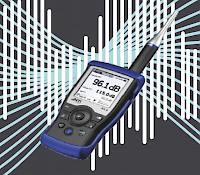
This is a modulated test signal,
measurable with class 1 sound level meters and dedicated software.
The procedure involves emitting the STIPA signal through the installed VAS loudspeakers and analysing it at points per zone, the number of which depends on the size of the building.
In these cases, verification is mandatory when the system is put into operation.
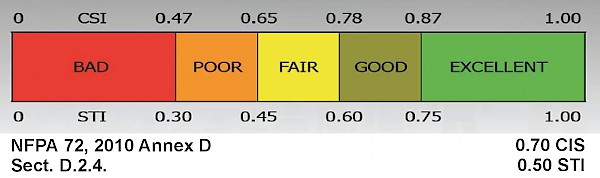
Once the measurement has been taken, we will obtain an STI value ranging from 0 (speech incomprehensible)
to 1 (perfect).
For VAS systems, the standard requires average values ≥ 0.50 and minimum values ≥ 0.45 in all measurement positions, in compliance with standards UNI ISO 7240-19, EN 54-16 and IEC 60268-16.
 In all locations where voice alarm communications are transmitted, the sound pressure level must be at least 6 dB higher than the ambient noise level over a period of 60 seconds.
Furthermore, at the listeners' location, it must not be less than 65 dBA or greater than 118 dBA.
Acoustic alarm signals intended to wake sleeping occupants must have a minimum sound pressure level of 75 dBA at the head of the bed, with all doors closed.
Where it is important that occupants, such as patients in hospital wards, are not subjected to stress caused by loud noises, the sound pressure level and content of the message should be such as to provide warnings to staff and minimise trauma.
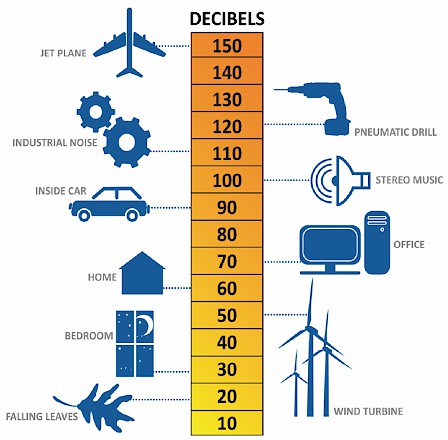
118 dBA Messages MAX Level
95 dBA Background noise MAX Level
(add optical devices)
75 dBA Rest areas MIN Level
65 dBA Messages MIN Level
Correct STI/STIPA measurement not only verifies compliance with the Fire Prevention Code, but also optimises safety in public, industrial and commercial buildings, reducing risks in emergency scenarios.
Reference standard: EN60268-16: Sound system equipment part 16, objective rating of speech intelligibility by speech transmission index